Emily Cox: Hi, this is Emily Cox, and today I'm so excited to be speaking with bestselling sci-fi writer, Edward Ashton. He is the author of Mickey7, recently released as a film called Mickey 17, from director Bong Joon Ho, as well as several other works, including his newest release, After the Fall. Welcome, Edward.
Edward Ashton: Thank you. And thank you so much for taking the time to speak with me today. I do really appreciate it.
EC: It's great. No, I'm super excited for this conversation. I'm sort of a newer fan. I would say I'm roughly halfway through the current Edward Aston canon. I've now listened to three of your books, but something that's really stuck out to me is how you pick away at a lot of the same themes—but in these incredibly distinct, wildly imaginative sci-fi worlds that you create. So, I wanted to start with the aliens. All the species that you've populated your stories with are so different, so I wanted to ask: How do you start building creatures that are not only so physically different from humans, but they also have really distinct psychological concerns?
EA: Yeah, I think, like most authors, I tend to pick at things that bug me, things that have interested me since I was a kid, really. And one of those things is the idea of the other mind. I think we, as humans, have a fascination with being able to communicate with something other than us. This goes back to, you know, you think about stories like Dr. Doolittle.
Why was that an interesting story? Because he could talk to animals, and we would really like to talk to animals. There are a million stories about talking animals and other kinds of creatures because I think we're lonely, and we want to be able to communicate with somebody that's not quite like us. And so, when I'm creating an alien species—or even something like an artificial intelligence, like I did in Mal Goes to War—one of the first things that I think about is how would the differences that that creature, or entity, has in terms of its physical form, in terms of how it experiences the world, affect the way it thinks? And so I try to start from first principles.
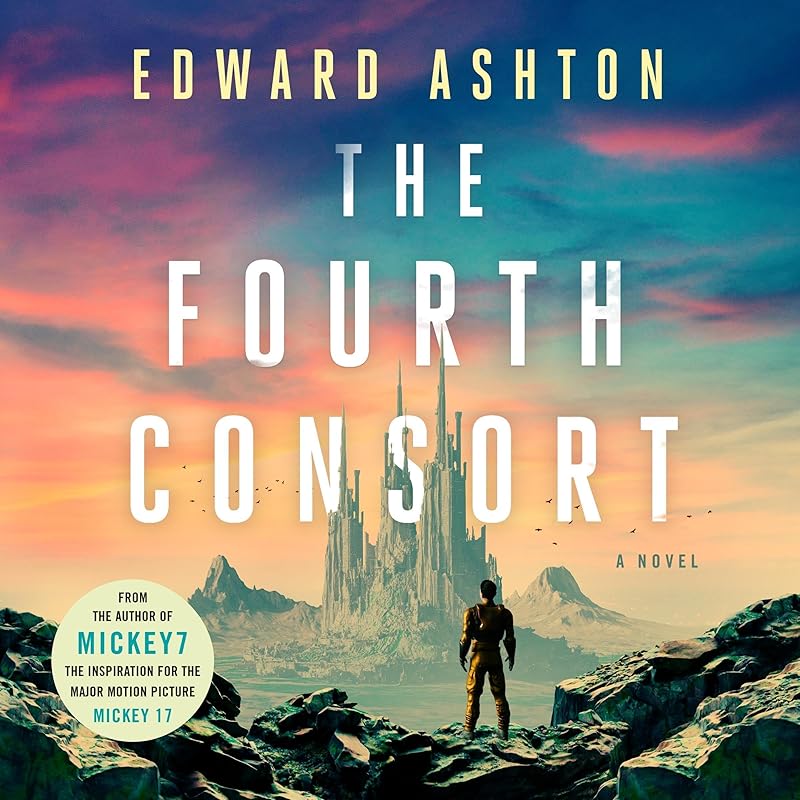
So, you know, in The Fourth Consort, my last release that came out last year, I invented these creatures that are sort of apex predators, really sort of terrifying apex predators. And the first thing I thought was, “How would evolving in that way change the way that you approach conflict, for instance. As humans, we've never been that way. I mean, we sort of have gotten there on this planet, at this time, through hook or by crook, but that's not how we evolved. We were sort of middle of the food chain creatures. And so, we're really focused a lot on communal action, and negotiation, and things like that. As a sort of a solo apex predator, you wouldn't be thinking that way. You see how, for instance, big cats respond to conflicts. When a cat is faced with something, even if it's 10 times its size, it responds with overwhelming violence.
EC: [Laughs]
EA: That's just how, if you ever see a video of a cat facing off with a bull or something, and they are not scared, because they are top of the food chain creatures. And so I wanted to have these aliens think that way and feel that way and then sort of play out how that would work in interactions with us. That's the general approach that I take with all of my creatures.
"The funny thing is, I actually like people. I'm pretty optimistic about us as a species."
EC: Yeah. The Fourth Consort's one of the other books I picked up, and I thought that was really interesting, how they just think entirely differently from the humans. But one thing, I think that all of your alien species, they kind of have bad news for the humans, don't they? I mean, they're sort of like a foil to who we are. They like to point out that we lie, and we're destructive, we're manipulative, and we employ trickery. What do you think's the worst thing about us? What's the biggest thing wrong with us?
EA: The funny thing is, I actually like people. I'm pretty optimistic about us as a species. I do have my creatures, and I'm just sort of using this generic term, my creatures, pointing out our faults and foibles. But I think that's sort of a mirror of how we look at other creatures. I'm trying to mirror that back to us, because what is the first thing we think about any strange thing or any strange creature that we meet? It's how it's different from us, and how that's bad.
EC: Mm-hmm.
EA: Right? And anything that's different from us, the first thing we think is that's a fault, it's a flaw, because we inherently think of ourselves as being correct. We think of ourselves as being the way things ought to be, and anything that's slightly different from us, we see not as a difference, we see it as a mistake. In the way that these other creatures are looking at us, I'm trying to mirror that back to us, and sort of show us: This is what you look like from the outside, maybe think about that a little bit.
EC: Right. So, let's dig into your newest book. In After the Fall, the grays are the alien species that have invaded and conquered Earth. We're potentially 100 years in the future, maybe further, but we're in a sort of post-apocalyptic environment, but on Earth. But the grays have effectively turned humans into pets. They've bred us down in size, and we're sort of bred in these nurseries called crèches and then bonded out. And the grays are kind of, at varying times, referred to as employers, or masters, or owners, but a lot of the book is trying to pick at what that relationship is like. But what I found really interesting about the grays is that they have a weird relationship to violence. Can you talk about this?
EA: Yeah, that, that was one of the linchpins of the book, and one of the linchpins of the plot. It was really a way to solve a problem for me, because the grays are so much bigger and stronger than humans, and I needed a way to make the humans relevant and sort of moderate the violence of the grays. So, yeah, the grays have this sort of psychological mechanism that causes them basically to be incapable of doing moderate amounts of violence to one another. And this partly comes from the fact that my sort of biological model for the grays was elephants.
I don't know if you're familiar with the phenomena of musth in elephants, which is where bull elephants basically have this hormonal thing that makes them become incredibly violent, and all the other elephants have to stay away from them while they're going through this. That was the basic model I had for the grays, what I refer to as “going absent,” or “absenting.” Basically, when they have an insult or an urge to violence, a switch flips in their brains, and they lose their sentience; they become basically wild animals for a period. And because of that, they have to be very polite to one another. And it affects the way that they think, and the way that they interact with one another. They can't be rude or insulting, because there's always this danger that the person you're talking to will go absent, and when that happens, it's a death match and nobody wants to get into that. And that affects the way they interact with humans as well. And I thought it was a really interesting sort of twist that obviously comes up big in the end of the book.
EC: Right, yeah. And when I was preparing for this conversation, I was like, "I need to avoid spoilers." But I also really want to make sure that we get into this a little bit, because it is so interesting. And I'm so glad you've explained it, because I was explaining it to my producer, who hasn't read the book, and I think I was not doing a very good job. So, it really is interesting. It's funny that you say elephants, because I was going to ask you, what do they look like? Because you give some limited descriptions, but I was sort of picturing upright rhinos, maybe. I mean, they have, like, this gray hide, and they've got tusks, but I don't know.
EA: Yeah, I try not to do this thing that you see in some old-timey science fiction, where you just sort of take an animal we know, put it in a human suit, and say, "Okay, there's your alien." Larry Niven was really big on that. And I love Larry Niven's work, by the way, but, yeah, that's a foible of his. My basic model was, maybe rhinos, maybe elephants, something like that, a big sort of herbivorous animal that has always been the master of its environment. It's the biggest, sort of meanest thing around; it's never really had any predators to worry about. Again, very different from the way that we evolved. And, then again, how does that affect your psychology? How does that affect the way that you interact with the world?
EC: Yep. So, speaking of psychology, I wanted to dig into your main characters a little bit, because there's certain sort of similarities among them. And a lot of this is where the humor comes from in your book, which I love so much. The levity comes from the main characters. They're all, at least in the books of yours that I've read, they're all operating just a little outside of the expected norms. They've blown up their lives in one way or another. And I was kind of debating how to characterize them. Are they misfits?
In another interview, you referred to Dalton from The Fourth Consort as fitting the “hyper-competent, broken man trope.” I was thinking about this a lot. Like, they seem to get themselves into trouble, but then they're the right people to get themselves out of trouble again. I don't know, it almost felt like a metaphor for neurodivergence. I mean, where do these main characters come from when you're writing them?
EA: The way that you described it was pretty good. I saw one reviewer, I think it was reviewing The Fourth Consort, who said: "Edward Ashton has come up with another one of his classic, just-some-guy trademark characters." Which I think is fair. I'm not somebody who believes, or is really interested in, like, the chosen one sort of trope, where you've got a main character who is a hero, he's pure, he always does the right thing. To me, that sort of character's not interesting.
"We think of ourselves as being the way things ought to be, and anything that's slightly different from us, we see not as a difference, we see it as a mistake."
I go back to The Lord of the Rings and look at Aragorn and Boromir, right? Aragorn is the Chosen One. He's the hero; he always makes the right decisions; he's hyper competent; he can defeat 500 men at one time with a sword, blah, blah, blah, blah, blah. Boromir's just some guy. He's only on this quest in the first place because his dad made him come. He didn't want to be there. But at the end of the day, when it really comes down to it, he makes the right choice, despite the fact that it costs him his life, he makes the right choice. And to me, that is a much more interesting character than the guy who always knew he was going to win.
So that's the kind of characters I try to write. I try to write Boromirs, not Aragorns. I try to write people who weren't setting out to be a hero. They're not a hero, they don't have any special skills, they don't have any amazing talents. They just sort of got thrown in this situation, and they do the absolute best they can—often really just trying to survive themselves. And, at the end of the day, you hope that they make the right choice, to sort of bring things to a good conclusion. And that's the path I try to follow.
EC: Right. Well, at the end, there's a moment always in your books where I'm like, "How are they gonna get out of this? I don't understand how he's going to survive." And that's where the fun and suspense comes from. But, I would say, the skill they do have is they're all practicing pretty smart diplomacy. Even if they sort of stumble into it, like, they're all diplomats in some way. How often do you think about diplomacy in your day-to-day life?
EA: Yeah, I mean that's something that I really try to touch on, because as humans, that's one of the few things we're really good at. I mean, if you look at how we stack up with other animals on this planet, we're not good at being animals, right? We're not strong; we're not fast; we don't have big teeth; we don't have sharp claws. What we're really good at is negotiating, cooperating, and collective action. Us and ants, you know?
We're the two best in the world at that one particular thing. So that's what I usually try to bring to the fore. You're talking about these other creatures who are sort of showing us in our worst light. But again, I actually like people, and I'm optimistic about people, and I try to turn around and show us in our best light. And here's some things that, you know, at the end of The Fourth Consort, here's something you didn't know we could do.
EC: Yeah. I love that moment.
EA: You know, here's a surprise. Didn't know that was going to happen. There are things that we're really good at. And yeah, negotiating diplomacy, being able to understand other people and mirror their thoughts back to them, you know, that's something that we actually are really good at, and I try to emphasize that in a lot of my books.
EC: Yeah. There's been this sort of increasing chatter in the last few years that we may be on the cusp of a first contact moment ourselves. Like with this documentary, The Age of Disclosure, and Luis Elizondo's book two years ago. Have you been following all this stuff? And what's your take on it?
EA: I am pretty skeptical about that.
EC: Okay.
EA: I fully believe that there are other intelligences out there, but at the same time, space is really big, and the distances between stars are really big, and our current physics doesn't give us a good way to get from one to the other. Of course, we have radio communications; somebody could send out a message to us from, you know, from 50 light years away. But then the question arises of: Why would they do that? Would that be an intelligent thing to do if you've read The Three-Body Problem, and you thought a little bit about the Dark Forest hypothesis? Anybody who thinks about this for very long realizes that might not actually be a smart thing to do. So I don't know if anyone would actually do that. And as far as physically visiting, there may be some physics that supports that, but our current physics says no. And so, until our current physics says, at least, “maybe,” I'm pretty skeptical.
EC: You're skeptical. Interesting. Well, in your day job, I mean, you're a cancer researcher, and also you lecture on quantum physics, is that right?
EA: Yeah, that's true.
EC: Okay. And how much do you draw on that work in your writing?
EA: Not a ton, because my day job's really boring.
EC: [Laughs]
EA: I mean, it's important stuff, but, you know, nobody wants to read about cytokine chains and things like that. And nobody wants to read a physics textbook, and nobody wants to read a cancer biology textbook—unless it's The Emperor of all Maladies, which is really, really good. You should read that for sure.
EC: Right, yeah.
EA: Where my science background comes in is to keep me from saying something stupid. That, I think is very, very important. For me, when I'm reading a science fiction book, when I get to a part where the author says something or has something happen, which is clearly 100-percent wrong and impossible, that pulls me out of the story right away. It's totally okay to have speculative things that we don't know about, like, you know, warp drives and things like that. That's cool. There could be things like that. We don't know. Like I said, our physics doesn't support it now, but it might in the future.
"I try to write Boromirs, not Aragorns. I try to write people who weren't setting out to be a hero."
But when you have something like, you know, you've got a story about orbital mechanics, and you clearly don't know how an orbit works, that's really problematic for me, and I really try not to do that sort of thing. And I think my scientific background helps me there, because I know what I know, and that helps me to know what I don't know and what I need to look up, or what I need to talk to some other expert about. So, I think I'm maybe a little less likely than somebody, you know, with a PhD in literature to sort of stumble into a big mistake that seems commonsensical to me, but actually is 100-percent wrong.
EC: Right. That's really interesting. Do you have to do a lot of research for your writing?
EA: Bits and pieces, because, yeah, I do like to get things right. You know, in Mickey7, for instance, I talk a lot about the amount of damage that's done by something at “relativistic velocity,” smacking into a planet. I had to look up all those equations and run the numbers because I wanted to get them right. Actually, my Czech translator for Mickey7 called me up and let me know that I had made a mathematical error in that book.
EC: [Laughs]
EA: And, as somebody with the background that I have, to be called out on a math error by a translator is pretty embarrassing.
EC: Oh my gosh.
EA: If anybody else finds that error—which is still there in the English editions—I will send you a dollar by mail. So, if you find that error and you want to point it out to me, I will be happy to reimburse you on that.
EC: Who is this translator? I mean, he's obviously multi-talented.
EA: Yeah—very attentive.
EC: [Laughs]
EA: Somebody with a real eye for detail. It was a subtle mistake, but he was absolutely... You know, I went back and checked, and he's absolutely right. So good on him.
EC: Amazing.
EA: Great eye; great catch.
EC: Yeah. So, I just watched Mickey 17 a few weeks ago. I was on a plane. It was the perfect plane movie for me. It was just so immersive. I'm not the best flyer, so I really loved having my mind taken away. What was it like having a book made into a movie? I mean, wasn't this optioned before the book even had a publisher?
EA: Yeah, this was a really surreal experience, and I cannot emphasize how improbable this whole stream of events was in how this is not how things are supposed to work, right? You're supposed to publish the book, it becomes a bestseller, and then studios get interested; it gets picked up, and so on. That is not what happened here at all. I submitted this book to my agent in December of 2019, and Warner Bros. optioned it in January 2020, with like less than 30 days after I handed this PDF to my agents, it was optioned by Warner Bros. Not only was it not published, we didn't even have a publisher for it at the time.
EC: Your agent sounds amazing [laughs].
EA: He is. He is truly an amazing person. Yes, absolutely.
EC: Yes.
EA: Absolutely true. I still do not know how this was pulled off. I assume he has some sort of, you know, dark wizard powers or something. But, you know, he got it done. But yeah, the entire experience was completely surreal. Not just to have it picked up as an option. I mean, that happens pretty commonly. The studios pick up, what, 30, 40, 50 properties for everyone that ever gets made into a movie.
You know, that's the first piece of advice I got, was: “Go ahead and spend that check; take your wife out to a nice dinner. Don't expect it's ever gonna get made into a movie because it's not going to happen. Don't think about it anymore.” It's, you know, this was nice, but it's over.
But then it just kept not being over. I guess it was 12 months after the option was picked up that director Bong [Joon Ho] formally signed on, and then the next thing you know, Robert Pattinson and Mark Ruffalo were signed on to the project. And things just kept spiraling. And I'm like, "This is actually gonna happen." For a long time, I was telling people, you know, I couldn't rule out the prospect that I was actually in an intensive care ward, on an IV drip, and my wife was just about to pull the plug, and I was just saying, "But please hold off until I see the film. As soon as I see the film, you can kick the plug out of the wall and we can be done with this." But I've seen the film. It actually came out, and I'm still alive, so I guess that wasn't true. I guess it all really did happen. So, here we are.
EC: Or you thought you were in a parallel universe there for a minute; you'd slipped off the timeline.
EA: Yeah, something.
EC: Yeah.
EA: Something, yeah. And I do want to emphasize also what a positive experience this was, top to bottom for me. You hear authors sometimes complain about how they get treated by Hollywood and blah, blah, blah, blah, blah. Everybody I dealt with, from the producers, to director Bong, to the actors that I met were absolutely wonderful, just the warmest, kindest people I ever met. At the premiere, I got to spend about two hours hanging around with Robert Pattonson's mom and his sisters. Absolutely wonderful people.
EC: Oh, wow.
EA: We had a really fun conversation. Director Bong himself—one of the kindest people I've ever met, one of the warmest people I've ever met—he did so many just nice things for me that he did not have to do throughout this process. I was just incredibly impressed with everybody in the entire production.
EC: Oh, that sounds amazing. It was really fun to see Mark Ruffalo as a villain. He seems like the warmest, kindest person, and he played that villain very, very well. Love that.
EA: I think he's done a little bit of a heel turn there, because in, was it Small Pretty Things? That's also very, very good. He plays a similar sort of smug, smarmy, and ultimately evil character in that one as well. Maybe he's trying to play against type a little bit in some of his newer projects, or take on a new persona. I don't know, but he does it well; he does it really well.
"Where my science background comes in is to keep me from saying something stupid."
EC: Yeah, yeah. So, on to the audiobook: How much say did you have in the casting process and the production of it?
EA: So, when I first started working with Mickey7, which I think was the first one of our books that came out in audio, they gave me a set of four narrators who had read sample chapters, and let me listen to them and sort of pick which one I thought was best. For some of my other books that have had different needs, we went with John Pirhalla as the main narrator, obviously, for Mickey7. He's worked me on a bunch of other books as well. I've gotten to know John pretty well at this point. Again, absolutely wonderful person and a huge talent in this space, obviously. We've been able to pull in other people, but it's always been sort of, "Here's three people we think might be good, give it a listen, let us know what you think." I don't think I ever have had final say on any of this, but they, at least they do solicit my opinions, which I appreciate.
EC: Right. And are you a listener yourself? Are you an audiobook listener?
EA: Oh, yeah. I love audiobooks. Absolutely. I don't have time to sort of physically read as much as I would like. I still do read a lot of hardcover books as well. But I'm a voracious consumer of literature, and I like to have it sort of coming into my head 24/7, if I can. I live in the middle of the forest. I live in a sort of a cabin in the woods. I've got dogs, and I take them out. We we walk four or five miles a day, and I've always got audiobooks sort of entertaining me as I go on those journeys.
EC: Oh, wow. I love it. What are some of your favorites, if you don't mind me asking?
EA: I've been on a real run of Adrian Tchaikovsky recently. Big, big Adrian Tchaikovsky fan, which is a great thing to be. Because if you love Adrian Tchaikovsky, you will never not have more things to listen to or read, because he puts out a new book every six weeks. The man is an absolute machine. I'm currently listening to Guns of the Dawn, which is one of his newer books—just absolutely brilliant stuff. I listen to his Dogs of War series. That's, yeah, like I said, I've been on Adrian for a while. I went through a John Scalzi kick for a while there.
EC: Oh?
EA: I went through his entire, sort of, Human Division series on audio as well. There are some books that I think do really well on audio. There are some books that, you know, that maybe I think reading physically is, is a better way to go. I feel like audio is better for light and breezy. Like, I wouldn't listen to James Joyce on audio. James Joyce, I need to sort of sit down and read. You know, like things where the sentence structure's really intricate and detailed and where the language is super, super important. I think, to me at least, physical reading is better. But more plot-driven stuff, I think goes really well with audio.
EC: Yeah. Nice. Yeah, no, I agree. I'm personally more of a fiction listener. I find that, you know, for me, referency stuff and wellbeing things might, you know... I want to be able to refer back and flip around.
EA: Yep.
EC: Yeah, for sure. So, I think my last question is: I've listened to three of your books, what should my next one be? What would you recommend? I've done Mickey7, After the Fall, and Fourth Consort, so...
EA: Okay, I mean, if you like Mickey7, Antimatter Blues obviously is a follow up. You should definitely do that. My two earliest books are just coming out in audio right now. The End of Ordinary just released. And Three Days in April, my debut, which came out in 2015, is finally coming out in audio in February. So, those are sort of full-cast narrations, which is, which is really fun.
EC: Oh, fun, okay.
EA: I love what they did with The End of Ordinary. They got four different narrators for the four main characters in Three Days in April. I'm really excited to see what they come up with that.
EC: Awesome. Well, I have a feeling I'm just going to make my way through the rest of the year and finish your whole list. And on that, I think we will wrap up. Thank you so, so much for talking with me today. I really enjoyed this conversation.
EA: Thank you very much. I really appreciate it as well.
EC: And listeners, you can get After the Fall and all other Edward Ashton books on Audible now.
Produced and edited by Melissa Bendixen, engineered by William Hall.