Making Change with your Money Podcast Por Laura Rotter CFA CFP® | Financial Advisor for Women in Midlife Transitions arte de portada

Making Change with your Money

Making Change with your Money

De: Laura Rotter CFA CFP® | Financial Advisor for Women in Midlife Transitions
Escúchala gratis

Making Change with Your Money is the go-to podcast for women in midlife experiencing major life transitions and ready to transform their relationship with money.

Hosted by Laura Rotter, CFA, CFP®—a financial advisor and Founder of True Abundance Advisors—this podcast features intimate conversations with women who have successfully navigated career changes, divorce and financial independence, retirement planning, entrepreneurship, and complete life reinvention.

Every episode explores both the practical side of financial planning for women and the deeper inner work around money mindset, worthiness, and values-based living. From healing financial trauma to building sustainable businesses, from leaving corporate careers to investing with confidence, these stories provide both inspiration and actionable financial guidance.

Whether you're contemplating a career pivot, managing an inheritance, recovering from divorce, or simply feeling that there must be more to life than the relentless pursuit of more—this podcast will help you use your resources (money, time, energy, and talent) to create a life of meaning and purpose.

Laura brings her Wall Street experience, mindfulness practice, and financial life planning expertise to help listeners understand that true abundance isn't about the numbers in your account—it's about the freedom to live authentically.

Perfect for: Women over 40, midlife career changers, recent divorcées, pre-retirees, women entrepreneurs, and anyone questioning whether they're worthy of pursuing their heart's desires.

Topics include: Financial planning, money mindset, career transitions, retirement alternatives, divorce and money, women's financial empowerment, entrepreneurship, investing, financial therapy, values-based financial planning, and life reinvention.

2025 Laura Rotter, CFA, CFP® | Financial Advisor for Women in Midlife Transitions
Economía Espiritualidad
Episodios
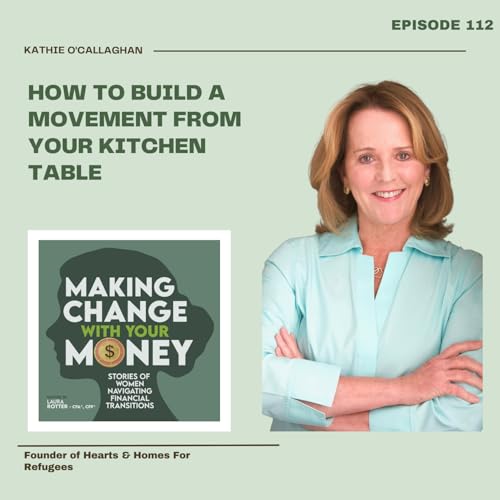
  • How to Build a Movement from Your Kitchen Table: with Kathie O'Callaghan
    Feb 7 2026

    What happens when you combine childhood memories of your mother opening your home to refugees, a crisis playing out on television screens worldwide, and the belief that ordinary people can make extraordinary change? You get Hearts and Homes for Refugees—a movement that has helped resettle and support over 1,000 refugees in the Lower Hudson Valley and inspired a national shift in how America welcomes those fleeing persecution.

    In this conversation, Laura sits down with Kathie O'Callaghan, founder of Hearts & Homes for Refugees. Kathie shares her journey from breaking barriers as the eldest daughter in a large Catholic family in Louisville, to working on Capitol Hill and in New York corporate PR, to stepping back to raise four teenagers, to founding an organization that would change the refugee resettlement landscape in America.

    When the Syrian refugee crisis erupted in 2015, Kathie remembered the Vietnamese family her mother helped resettle in the 1970s through their parish. She knew there was a model that worked—faith communities and neighbors providing extended support beyond what government-funded resettlement agencies could offer. So she gathered people around her kitchen table in Pelham Manor and said: We can do this. And they did. Now, the community sponsorship model Hearts & Homes pioneered has spread nationwide, with millions of Americans stepping up to welcome Afghan and Ukrainian refugees.

    This episode is essential for anyone who's ever thought "someone should do something" about an issue they care deeply about, for women wondering if they can make a difference after stepping back from careers, and for anyone seeking inspiration about what's possible when you trust your gut, mobilize your community, and refuse to accept that the way things are is the way things have to be.

    Key takeaways:

    💡 Your childhood experiences can become your life's mission—decades later: Kathie's mother opened their Louisville home as a "revolving door" to Vietnamese refugees, homeless people, and anyone needing help in the 1970s. Forty years later, watching the Syrian crisis, those childhood memories became the blueprint for Hearts & Homes for Refugees.

    💡 The best solutions often come from models that already worked: Kathie didn't invent refugee sponsorship—she remembered it from her childhood and adapted it for 2016. Sometimes innovation isn't creating something new; it's recognizing what worked before and bringing it back when it's needed again.

    💡 You don't need permission or a roadmap to start something important: In 2016, resettlement agencies said community sponsorship wouldn't work. Kathie said "watch us" and gathered people around her kitchen table. That model reshaped refugee resettlement nationwide. Sometimes you just have to build it and trust they'll come.

    💡Success isn't about money—it's about impact, one family at a time: Kathie defines success as seeing her vision come to life, bringing diverse communities together, and knowing that every single volunteer—whether leading a cohort or driving once a month—feels they're doing the most important work they've ever done.

    Connect with Kathie: Facebook LinkedIn Instagram X Website Advocacy Toolkit

    Más Menos
    48 m
  • How to Lead Yourself First: The CORE Framework for Intentional Living with Miki Feldman Simon
    Jan 24 2026

    What if the most important leadership role you'll ever have isn't managing a team, but leading yourself? In this conversation, Laura Rotter sits down with Miki Feldman Simon—executive coach and author—who shares her journey to discovering her true calling: helping people live with intention, authenticity, and purpose.

    Miki's path wasn't linear. From fashion design to psychology to HR to operations to marketing, she explored diverse fields while developing a consistent through-line: curiosity about people and the ability to create psychological safety that gets others to open up. After moving from Israel to Australia to the United States, taking forced career breaks due to visa restrictions, and taking care of aging parents, Miki found herself asking the fundamental question that drives her work today: Who do you want to be?

    Her answer became the CORE framework—a four-step process detailed in her book Core Leadership. CORE stands for Clarify, Operationalize, Reflect and Evaluate. This isn't just a leadership model for executives—it's a framework for anyone who wants to stop being managed by other people's priorities and start showing up as the person they truly want to be.

    This episode is essential listening for anyone feeling pulled along by life rather than intentionally choosing it, for parents trying to model values for their children, for professionals wondering if their credit card statement reflects what they say matters most, and for anyone ready to ask: In this moment, who do I want to be?

    Key Takeaways

    💡 Leadership starts with leading yourself—it happens everywhere: You don't need a management title to be a leader. Leadership shows up in your kitchen, with your family, in how you respond to stress. If you're not intentional about leading yourself, you'll be managed by other people's priorities and habits, pulled along without direction.

    💡 Ask others about your strengths—you can't see them clearly yourself: Miki asked her teenage daughter "What are my strengths?" and received a life-changing answer: "You have simple solutions to complex situations." We dismiss compliments or assume everyone has our gifts. Ask at least three people who know you well what your strengths are—the answers will surprise and empower you.

    💡 Clarify who you want to BE, not just what you want to DO: We spend enormous energy on what we want to accomplish but rarely ask who we want to be. When your values, priorities, and vision of yourself are clear, decisions become easier—even painful ones—because you have a compass guiding you.

    💡 Your credit card statement reveals your true priorities: Say family is your priority? Check your calendar and bank statement. We rationalize that we'll "someday" focus on what matters, but operationalizing your values means your actions actually align with what you say is important.

    Resources: Core Leadership

    The 6 Types of Working Genius

    Más Menos
    45 m
  • How to Take a Power Pause in Your Career Without Losing Your Ambition with Lisa Cassidy
    Jan 10 2026

    What does it take to walk away from 15 years at a prestigious company like IBM when you're ambitious, driven, and have two young children at home? In this deeply practical conversation, Laura Rotter sits down with Lisa Cassidy—former IBM consultant and organizational change specialist—who shares her journey of taking what she calls a "power pause" to recenter herself and her family after feeling stretched too thin.

    Lisa grew up in a log cabin in rural Maryland, where her parents made intentional choices about money—no mortgage, modest vacations, but heavy investment in education. Those early lessons about values over lifestyle gave her the foundation to make bold decisions decades later. After spending her twenties exploring three different industries in three different cities, earning her MBA, and building a successful 15-year consulting career, Lisa heard a quiet voice saying "you're doing too much." With the support of her husband David, she made the intentional decision to resign—but not before taking a leave of absence to ensure she was making the choice from a place of calm, not chaos.

    This episode is essential listening for any woman who feels like she's barely keeping her head above water, any parent trying to balance career and family, or anyone wondering if it's possible to pause without losing momentum. Lisa shares the financial preparation that made her pause possible, the questions she and her husband answered together to align on money values, and why success is really about the ability to choose how you spend your time.

    💡 Education as generational wealth can enable life choices: Lisa's parents lived in a small home without a mortgage and skipped fancy vacations to invest heavily in their daughters' education—including boarding school and college. This pattern, passed down from her grandfather paying for her father's law school, gave Lisa the foundation to later afford her own power pause.

    💡 Know yourself before you know your next role: Through exploring three different industries in three different cities in her twenties, Lisa learned that relationships and variety were more important to her than any specific field. Knowing what motivates you—not just what sounds impressive—is critical to long-term career satisfaction.

    💡 One in three working women will pause in the next two years: According to The Power Pause by Neha Ruch, one in three women currently working will pause their careers in the next two years, and 90% will return. You're not alone if you're considering this.

    💡 Make the decision from calm, not chaos: Lisa took a leave of absence before resigning to ensure she was making the choice from a centered place, not from burnout. She worked with a coach, journaled extensively, and had deep conversations with her husband about money values before taking the leap.

    💡 Success is the ability to choose how you spend your time: By buying a small house in Maine where cost of living is lower, sending kids to public school, and being intentional about expenses, Lisa and her husband created the financial flexibility to have choices. Money enables choice, but choice is the real measure of success.

    Connect with Lisa:

    LinkedIn

    Resources:

    The Power Pause

    Suzy Welch Podcast

    Más Menos
    39 m
Todavía no hay opiniones