

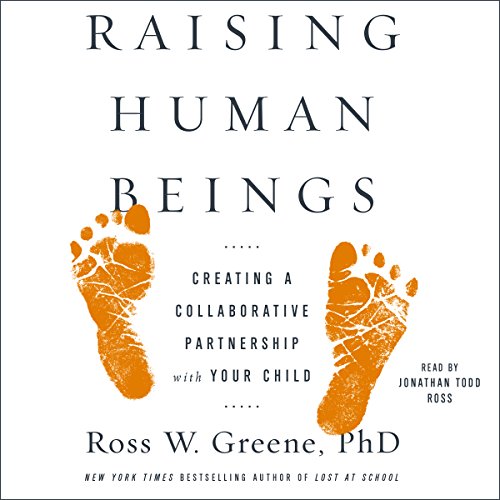
Raising Human Beings
Creating a Collaborative Partnership with Your Child
Failed to add items
Sorry, we are unable to add the item because your shopping cart is already at capacity.
Add to Cart failed.
Please try again later
Add to Wish List failed.
Please try again later
Remove from wishlist failed.
Please try again later
Adding to library failed
Please try again
Follow podcast failed
Please try again
Unfollow podcast failed
Please try again
$0.00 for first 30 days
LIMITED TIME OFFER
Get 3 months for $0.99/mo
Offer ends January 21, 2026 11:59pm PT
 Prime members: New to Audible? Get 2 free audiobooks during trial.
Just $0.99/mo for your first 3 months of Audible Premium Plus.
1 audiobook per month of your choice from our unparalleled catalog.
Listen all you want to thousands of included audiobooks, podcasts, and Originals.
Auto-renews at $14.95/mo after 3 months. Cancel anytime.
Pick 1 audiobook a month from our unmatched collection.
Listen all you want to thousands of included audiobooks, Originals, and podcasts.
Access exclusive sales and deals.
Premium Plus auto-renews for $14.95/mo after 30 days. Cancel anytime.

Raising Human Beings
Narrated by:
Jonathan Todd Ross
Buy for $14.99
-
Narrated by:
-
Jonathan Todd Ross
Parents have an important task: figure out who their child is—his or her skills, preferences, beliefs, values, personality traits, goals, and direction—get comfortable with it, and then help them pursue and live a life according to it. Yet parents also want their kids to be independent, but not if they are going to make bad choices. They want to avoid being too overbearing, but not if an apathetic kid is what they have to show for it. They want to have a good relationship with their kids, but not if that means being a pushover. They don’t want to scream, but they do want to be heard. Good parenting is about striking the balance between a child’s characteristics and a parent’s desire to have influence.
Dr. Ross Greene “makes a powerful case for rethinking typical approaches to parenting and disciplining children” (The Atlantic). Through his well-known model of solving problems collaboratively, parents can forgo timeout and sticker charts; stop badgering, berating, threatening, and punishing; allow their kids to feel heard and validated; and have influence.
From homework to hygiene, curfews, to screen time, Dr. Greene “arms parents with guidelines that are clear, doable, and sure to empower both parents and their children” (Adele Faber, coauthor of How to Talk So Kids Will Listen). Raising Human Beings is “inspirational…a game-changer for parents, teachers, and other caregivers. Its advice is reasonable and empathetic, and readers will feel ready to start creating a better relationship with the children in their lives” (Publishers Weekly, starred review).
Listeners also enjoyed...




People who viewed this also viewed...


Great book
Something went wrong. Please try again in a few minutes.
Dr. Greene certainly has a general philosophy that comes through in his book, but it's a very pragmatic philosophy. His assertion is that things will be better for everyone if you collaborate to resolve problems instead of using power to coerce obedience. One of the big differences is that Dr. Greene isn't suggesting that you change the goals you have for your kids (finishing homework, cleaning up their room, treating their siblings respectfully, etc.) he's just showing you how best to work with your kids to help them meet your expectations.
What makes this book so helpful is that Dr. Greene provides step-by-step instructions and even scripts you can follow. He tells you what to say, when to say it, and how to say it. For someone struggling to make changes to their parenting, this can be extremely helpful. Having a script can help keep you from falling into the patterns you're hoping to change.
My only real complaints about the book are very minor. For one, Dr. Greene refers to coercion as "Plan A" throughout the book, even though that's the method he doesn't recommend. Every time I've ever heard the phrase "Plan A" used in the past, it's been in reference to a course of action that should be done first, as your primary choice. Having him use it in the exact opposite of the traditional sense is confusing, especially since there doesn't seem to be any reason behind it. He very easily could have chosen different nomenclature for his system to avoid confusion. I also think that he sells himself a bit short. He recommends using this system only when things are calm and relaxed, usually after a conflict has occurred. I've noticed a number of times where his system would work perfectly in the moment in my own life, when one of your children is doing something you don't want them to do, but when nobody is yet losing their cool. I think including a short section on using his methods as a preventive measure instead of waiting until they've already gone bad would have been helpful, and would have demonstrated the versatility of this powerful system.
A very strong 4.5 stars from me! This is one of those books I immediately wanted to share with all of my friends because it offered such an innovative and pragmatic solution to problems we all face.
Great parenting advice!
Something went wrong. Please try again in a few minutes.
Transformative!
Something went wrong. Please try again in a few minutes.
I enjoyed learning how to be a more empathetic
Something went wrong. Please try again in a few minutes.
Great "sequel" to Explosive Child!
Something went wrong. Please try again in a few minutes.