

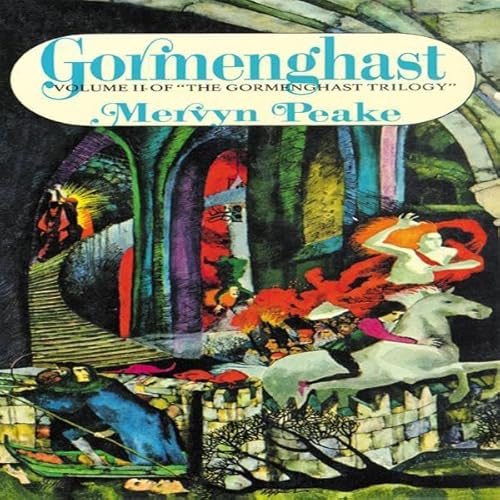
Gormenghast
Volume 2 of the Gormenghast Trilogy
No se pudo agregar al carrito
Add to Cart failed.
Error al Agregar a Lista de Deseos.
Error al eliminar de la lista de deseos.
Error al añadir a tu biblioteca
Error al seguir el podcast
Error al dejar de seguir el podcast
 Exclusivo para miembros Prime: ¿Nuevo en Audible? Obtén 2 audiolibros gratis con tu prueba.
Gormenghast
Compra ahora por $26.88
-
Narrado por:
-
Robert Whitfield
-
De:
-
Mervyn Peake
In this second volume, Titus comes of age within the walls of Gormenghast Castle and discovers various family intrigues. His twin aunts, Cora and Clarice, have been imprisoned in their own apartments, believing that they alone among the castle inhabitants were free of a hideous disease referred to as "Weasel plague." Titus has discovered secret hiding places in abandoned parts of the castle from which he can watch and learn, unobserved: for he has been "exiled" to grow up with the common children until the age of 15. And so, not feeling connected to his future responsibilities, Titus drifts back and forth between the complicated social world he will grow up to govern, and a world of fantasy and daydream.
©2000 Mervyn Peake (P)2000 Blackstone AudiobooksLos oyentes también disfrutaron:


Reseñas de la Crítica
"[Peake's books] are actual additions to life; they give, like certain rare dreams, sensations we never had before, and enlarge our conception of the range of possible experience." (C.S. Lewis)
Las personas que vieron esto también vieron:




There are many memorable set pieces in the novel, like the moment when Titus and his sister Fuchsia discover that they love each other, the “Bachelorette” soiree at the Prunesquallors, the demise of an anile headmaster, the game of marbles in the Lichen Fort, the tracking of a satanic outlaw, the aborted ceremony of the Bright Carvings, the encounter with the wild Thing in the forest cave, the Biblical flooding of the castle, and the schoolboy game featuring a classroom window 100 feet above the ground, a giant plane tree, a pair of polished floor boards, and a gauntlet of slingshots.
Reader Robert Whitfield’s narrator is clear, refined, and sympathetic, and his character voices varied and on target (especially Dr. Prunesquallor, Irma, Bellgrove, Barquentine, Steerpike, and Flay). But his Fuchsia needs more raw passion and less nasal whine and his Countess Gertrude more gravitas and less dowager quaver. And there is an odd glitch whereby about twenty times during the course of the book Whitfield’s sentences jarringly repeat.
Gormenghast resembles Titus Groan, the first novel in the trilogy. Both novels are set in a vividly realized castle world populated by grotesque denizens. Both intoxicate the reader with rich language, baroque detail, painterly description, and blended humor and pathos. Both leave images etched upon the mind’s eye. Both feature long passages of conversation or description punctuated by unpredictable scenes of suspenseful action. Both express themes about the primacy of passion and imagination over reason and calculation and the comforting and stultifying influence of tradition on human lives. Although both novels are “fantasies of manners,” however, Gormenghast is also a romantic comedy, a British school story, a gothic thriller, and a bildungsroman. And it highlights new themes: the conflict between duty and freedom and the transformations, wonders, and absurdities of love and aging.
Finally, Gormenghast, like Titus Groan, is a unique masterpiece that offers a satisfying conclusion to the story arc of the first two novels that perhaps renders the third book, Titus Alone, unnecessary.
A “Supernaturally Outlandish” Masterpiece
Se ha producido un error. Vuelve a intentarlo dentro de unos minutos.
For some irritating reason, a number of sentences are repeated. It's an annoying glitch that breaks the flow. But the book as a whole isn't affected.
Great re-read after 50+ years
Se ha producido un error. Vuelve a intentarlo dentro de unos minutos.
As good as writing gets.
Se ha producido un error. Vuelve a intentarlo dentro de unos minutos.
Not just a book - an experience!
Se ha producido un error. Vuelve a intentarlo dentro de unos minutos.
The narrator is superb as usual. On a technical level the recording leaves much to be desired. There are several instances where a passage is repeated instead of being edited out - at one point it was about 3 minutes. There are also long silences. This points to a lack of attention to detail but not to the overall enjoyment of the masterpiece.
Dickens in our time
Se ha producido un error. Vuelve a intentarlo dentro de unos minutos.